

Most BCBAs didn’t enter this field to spend their afternoons tracking down incomplete session notes or pulling together billing reports. They got into ABA to deliver care.
But the job has shifted. According to RethinkBH’s BCBA State of the Profession Survey, 61% of BCBAs say administrative burdens interfere with their ability to provide direct care, and 89% experience work-related stress. BCBAs report spending 38% of their week on billable services that aren’t therapy, while direct client care accounts for just 25% of their time. For clinician-owners, every operational gap is also a business problem.
AI won’t fix all of that. But it has the potential to address the specific places where administrative work crowds out clinical work.
Note: RethinkBH is integrating AI across its practice management platform: from AI-enhanced session notes to an AI dashboard that shows you what needs your attention across your practice. Talk to us about how RethinkBH can optimize operations at your practice.
1. Simplified ABA Reporting
Most ABA practices don’t have a data problem: they have an access problem.
The old process is familiar: log into one system for scheduling, another for progress notes, a third for billing status. Export a report, open a spreadsheet, start cross-referencing. By the time you have a real picture of your practice, the morning is gone. This isn’t a rare occurrence. Nearly 45% of BCBAs still use some manual processes to track, measure, and report client progress, according to the same survey.
AI changes this at the source. Instead of generating reports on demand, it monitors practice-wide data continuously and surfaces what needs attention. You log in and see a ranked list of issues organized by risk and priority, not by the default order of a report..
No manual exports. No cross-referencing between systems. Just a clear order of actions drawn from data already in the platform.
For clinicians or practice owners managing a growing caseload or adding new locations, the difference isn’t marginal. It’s the difference between starting the day with a plan and starting it with a stack of open questions.
For a closer look at how AI fits into the broader clinical picture, this RethinkBH resource on ethical AI in Behavioral Health offers 5 key principles practitioners should understand.
2. Improved Patient Outcomes
Clinical drift, where a treatment plan gradually deviates from its intended implementation, is one of the harder problems in ABA. A skill target stalls. A behavior data gap grows. A treatment plan falls behind its implementation schedule. None of this happens all at once. It builds quietly across multiple clients until the gap is large enough to notice.
By then, course-correcting takes more time and effort than it would have earlier.
AI monitoring watches clinical activity across the full caseload, not just the clients you reviewed last week. It tracks treatment plan implementation, learner progress, stalled skill targets, missing behavior data, and progress monitoring gaps. When it detects a slowdown, it flags it early.
That early notification matters. A clinician who hears about a stalled skill target in week two has options. A clinician who hears about it in week six is managing a setback.
This is proactive clinical decision-making. It doesn’t replace the clinician’s judgment. It makes sure that judgment gets applied before the window closes.
3. Practice-Wide Visibility From One Dashboard
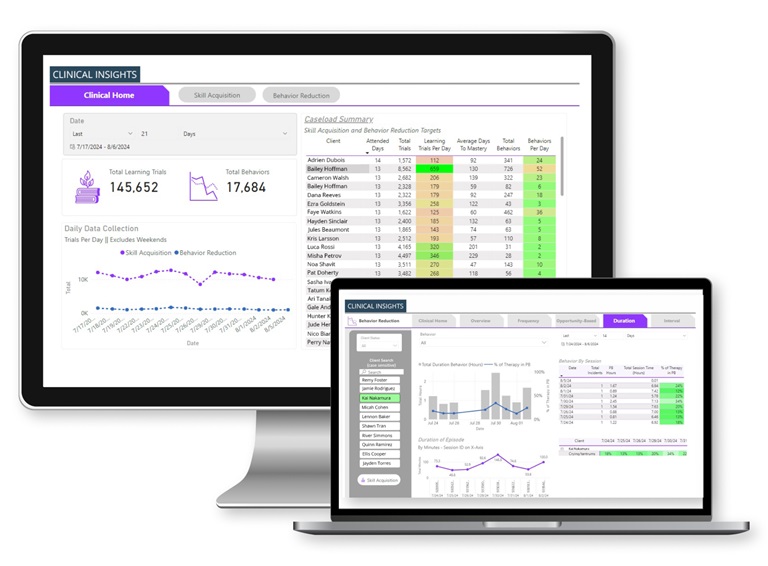
Running an ABA practice means managing multiple clinicians, multiple clients, and often multiple locations. Getting a complete picture of operations has traditionally meant building it yourself, from pieces.
Most BCBAs know this process well: pull incomplete appointment data from one place, check session note completion in another, review attendance patterns manually, then try to reconcile everything into a picture of where the practice actually stands.
An ABA AI dashboard eliminates that assembly process. It consolidates incomplete appointments, missing session notes, documentation gaps, and attendance patterns into a single view across all clinicians, clients, and locations.
The visibility is real-time. There’s no report to build first, no data to combine. What would have taken an hour to gather is available at login.
If you’re overseeing a growing team, this goes beyond convenience. When you can see the full picture without manually pulling it together, you can act on it. That’s the difference between managing your practice and reacting to it. RethinkBH’s analytics solution offers a related layer of this visibility, with caseload-level insights across therapists and locations.
4. Faster Issue Resolution
Spotting a problem is only half the work. Acting on it quickly is what protects care quality and revenue.
Traditional workflows create friction at every step. You identify a documentation gap in one screen. You navigate to another screen to find the session. You check a third place to see who owns it. By the time you’ve completed that loop, you’ve spent more time on the process than on the problem.
AI flags specific issues and connects each one directly to the place in the platform where it can be resolved. Incomplete appointments, missing session notes, stalled skill targets, missing behavior data, and documentation gaps approaching compliance risk are all surfaced and linked.
The result is fewer steps between identifying an issue and closing it. You’re not navigating between menus or hunting for context you already pulled up once. The flag and the fix are in the same place.
Faster resolution protects two things at once: care quality and revenue. A documentation gap closed in 24 hours doesn’t become a billing problem. A stalled skill target caught this week doesn’t become a clinical setback next month.
5. Data Access for Your Entire Team
In most ABA practices, pulling data requires knowing how to pull data. Front desk staff, billing coordinators, and newer BCBAs often can’t get answers on their own. They have to wait for someone who knows how to run a report.
That creates a bottleneck that shows up everywhere: delayed billing follow-up, slower onboarding, questions that take days to answer when they could take minutes.
Natural language search removes that barrier. Any team member can type a plain question and get a focused answer, without needing to know query logic, access a reporting module, or ask someone else.
The practical effect is that operational data becomes available across the practice, not just to the people who already know how to find it. A billing coordinator can check claim status without routing the question to a supervisor. A newer BCBA can pull a client’s session history without waiting on their clinical director.
This isn’t about adding a feature. It’s about making information accessible to the people who need it, when and how they need it.
AI Won’t Replace Clinical Judgement. It Will Protect Your Time to Use It.
Every one of these capabilities points the same direction. AI doesn’t make clinical decisions. It handles the work that sits between a clinician and the information they need to make those decisions.
For practice managers and BCBAs, that’s a meaningful distinction. The administrative burden filling so many clinical hours isn’t inherently necessary. It’s the product of disconnected systems and manual processes that haven’t kept pace with what ABA practices actually need.
The RethinkBH AI Dashboard is built specifically for ABA practices. It brings real-time reporting, practice-wide visibility, issue resolution, and natural language data access into one place— designed around how ABA practices actually work. If administrative work is crowding out clinical work at your practice, it’s worth a closer look.
Request a demo to see how Rethink’s AI Dashboard, as well as our AI-enabled billing, scheduling, and session note features, can change your practice.
References- RethinkBH. (2025). BCBA State of the Profession Survey 2025: Navigating Urgent Challenges and Shaping the Future.