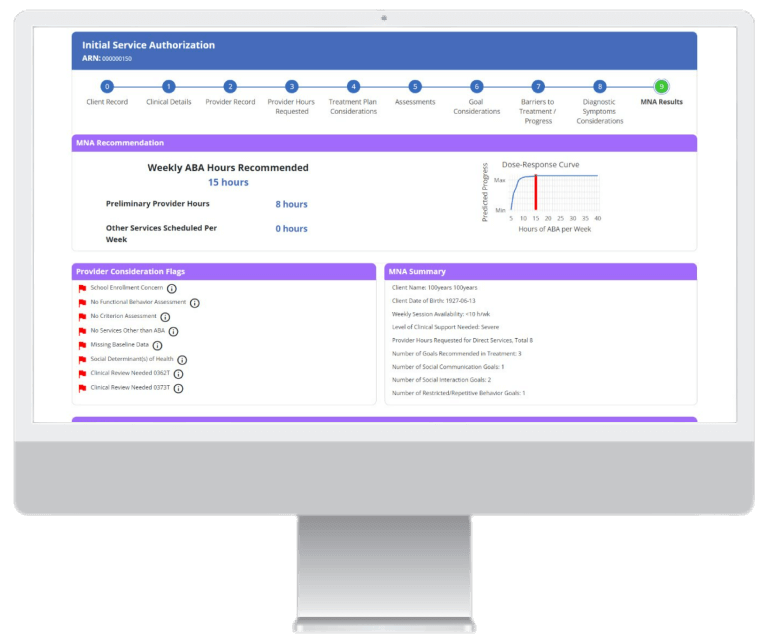
RethinkBH’s AI-driven patent-pending clinical decision support tool for guiding treatment plan recommendations.
Because when dosages are optimized,
Olivia’s needs are personal
Research shows that ABA treatment for autism is most effective when treatment intensity and clinician adherence to recommended dosage are optimized.
Proper dosage can significantly improve skill acquisition, behavior reduction, and overall outcomes. However, challenges such as communication barriers, insufficient clinician training, policies and benefit limitations from funding sources, and limited research can negatively impact these outcomes.
Leveraging millions of data points, Rethink’s patent-pending Medical Necessity Assessment tool is now driven by cutting-edge AI and clinical best practices. Powered by the world’s largest published dataset of autism services data, our tool provides accurate, patient-specific, optimized ABA dosage recommendations, ensuring the best possible outcomes for individuals with autism.
Users of the Medical Necessity Assessment can expect – among other benefits – AI-powered objective ABA dosage individualized per client need, consistency across authorizations (per BCBA and across practices), automated flags to highlight possible gaps in care/treatment, a path to more informed conversations with caregivers, and optimized treatment plan quality and outcomes.
Request a demo today to learn how to access Rethink’s Medical Necessity Assessment tool.
Bridge the language barriers with payors and caregivers when it comes to getting your requests approved and family adherence to treatment.
Provide your staff with a standard for documentation when submitting treatment plans to ensure clinical reports meet funders’ requirements.
Train clinicians to appropriately recommend ABA dosages for clients by embedding the Medical Necessity Assessment tool into the decision-making process.
Contribute to future research to strengthen prescription recommendations across populations and optimize clinical outcomes for clients.
The platform includes a Medical Necessity Assessment tool that helps clinicians justify treatment hours, improve documentation accuracy, and streamline insurance approvals.
The MNA helps ABA providers strengthen insurance authorization by offering evidence-based, objective, and well-documented treatment plan recommendations. Some of the benefits include:
Improved communication with caregivers & payers: The tool can help providers explain and justify treatment hours more clearly, reducing pushback.
RethinkBH’s MNA draws on multiple data points and clinician inputs to produce evidence-based dosage recommendations. Key inputs include:
This combination helps ensure that suggested ABA hours are tailored to each client’s needs rather than using a “one-size-fits-all” approach.
Clinics can design flexible therapy programs by combining assessment tools, modular treatment plans, and practice management technology. Data-driven adjustments, secure patient portals, and standardized templates help ensure care is personalized, compliant, and easy to manage.

Typically, the MNA should be used initially when you are recommending treatment for a new client, then updated or re‐authorized periodically to ensure treatment remains appropriate. Specifically:
Co-Owner
at Accelerate ABA
Introduction As professionals in the field of Applied Behavior Analysis (ABA), we have a unique...
Data discussed is based on prior version of the Medical Necessity Assessment (MNA) tool. MNA...